
If you are choosing between a Weber and a Blackstone, you are really choosing between two ways of cooking. A Weber gas grill cooks food over open grates under a lid. A Blackstone cooks on a solid flat steel surface with no lid. Most of the weber vs blackstone debate goes away once you decide what you want on the plate on a typical Saturday.
This guide walks through what each cooker does well, how each behaves when you are new to it, what cleanup looks like, and how much room it takes on a patio. It ends with a short decision guide and a case for owning both.
The real question: do you want grill marks or a flat-top?
Grates and a flat plate transfer heat differently. On a grill, only the grate bars touch the food, which is where the sear lines come from. Fat that drips onto the burners or flavorizer bars vaporizes and rises as smoke, and that smoke is a big part of what people mean by a grilled taste. The lid lets you trap heat and cook food through without flipping it constantly.
On a flat-top, the whole underside of the food touches hot steel. That gives you an even, deep crust from edge to edge, and it lets you cook things that would fall through grates: eggs, diced onions, rice, chopped vegetables, thin slices of meat. The food cooks in its own fat and whatever oil or butter you add, so the flavor is browned and savory rather than smoky.
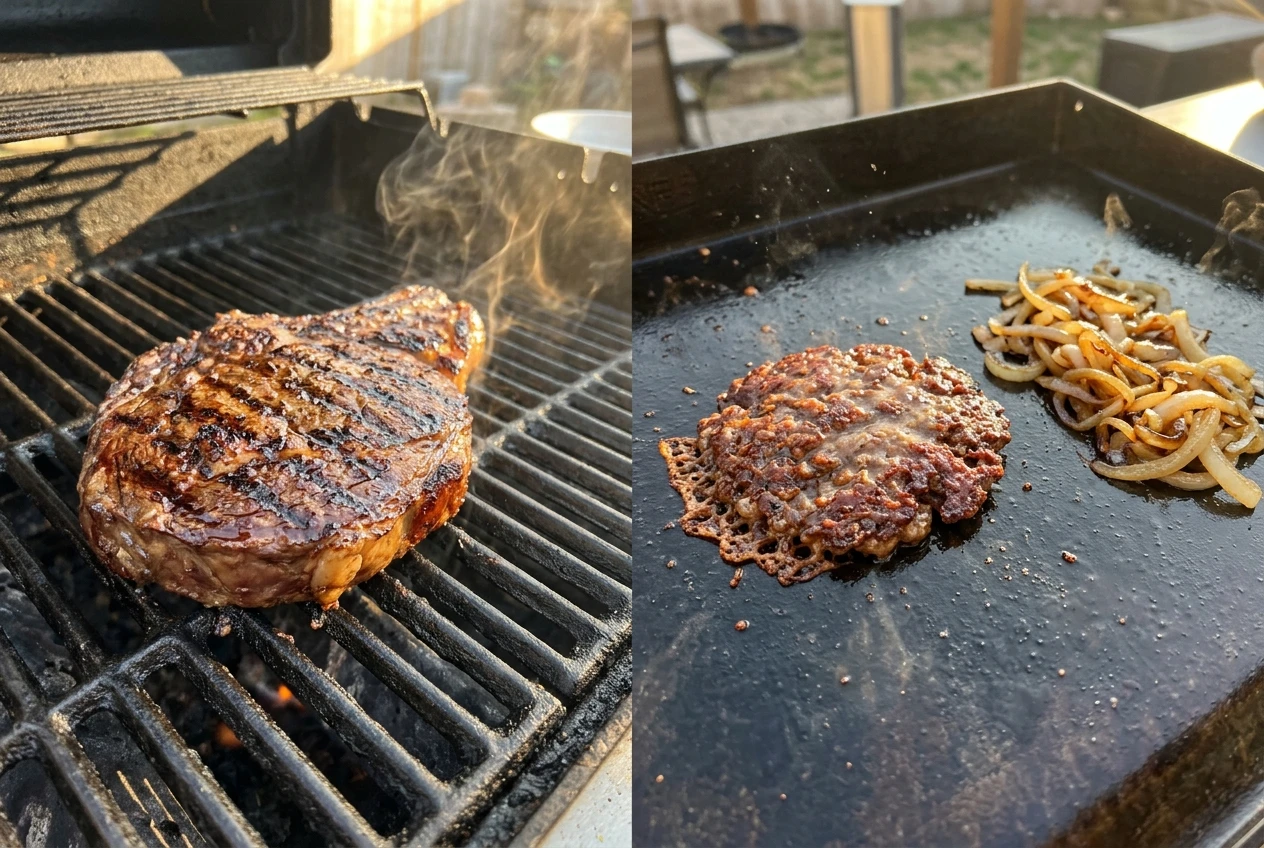
Neither surface is better in general. If your ideal Saturday plate has char lines and a smoky edge, you want the grill. If it has a crust all the way across and a pile of sautéed onions next to it, you want the griddle.
One more thing to know: Weber also makes a griddle, so “Weber vs Blackstone” can mean grill against griddle or griddle against griddle. The Weber Slate and the Blackstone 28 are covered in separate reviews, linked at the end of this article.
What each cooker does best on a Saturday
Here is how each cooker handles the foods weekend cooks make most often.
Steaks
A gas grill is the natural choice for steaks. Set up two zones, with one side on high for searing and the other lower for finishing, and you can handle a thick cut from start to finish with the lid down. The grates give you the classic look, and rendered fat hitting the heat adds smoke flavor. Our piece on direct grilling techniques covers how to manage the sear.
A griddle also makes a very good steak, just a different one. You get a wall-to-wall crust, and you can baste with butter, garlic and herbs right on the surface. The trade-off is that the steak sits in its own rendered fat, which makes more smoke and grease on the plate, and there is no lid for finishing a very thick cut.
Burgers and smash patties
Standard thick burgers work well on either. On a grill they pick up smoke and a bit of char, and you can melt cheese under the lid. On a griddle they brown evenly and stay juicy in their own fat.
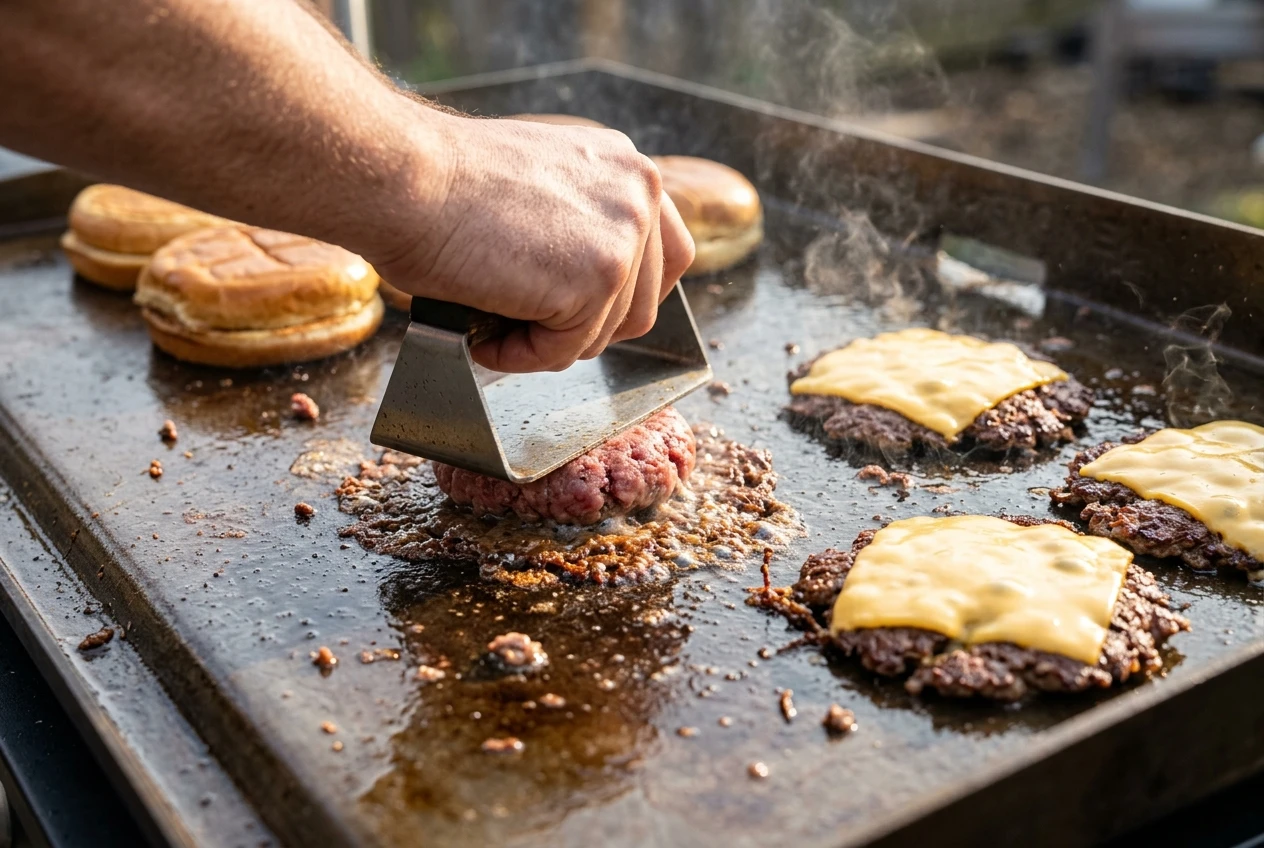
Smash patties belong on the griddle. The technique is to press a loose ball of beef flat against hot steel so the whole surface browns into a lacy crust. On grates you cannot do that, because the meat sticks, tears and drops fat into the burners. If smash burgers are what your family asks for, that point alone may decide it.
Breakfast
This is the simplest call in the whole comparison. Pancakes, eggs, bacon, hash browns and French toast all want a flat surface. A grill can do some of it with a cast iron pan or a plancha insert, but a griddle does it all at once on one surface, with room left over for toast. If a weekend brunch for the family is part of your plan, a griddle earns its space.
Big crowds
Both can feed a crowd, but in different ways. A griddle gives you a large continuous surface, so you can cook a dozen smash patties, a pile of onions and a batch of buns at the same time. That suits tacos, fajitas, cheesesteaks and fried rice, and our Blackstone griddle recipes show how far that goes.
A grill with a lid is better when the menu is bigger cuts: whole chickens, bone-in pieces, ribs, roasts and thick pork chops. With the burners set for indirect heat, it works like an outdoor oven. Griddles generally do not do this well because there is no lid to hold the heat around the food.
Heat control and learning curve: how each one behaves when you’re new
A beginner on a gas grill usually meets the same problems: flare-ups and uneven heat. Fat drips, catches fire, and chars the outside of the food while the inside is still raw. The usual fix is to set up a cooler zone to move food to, trim excess fat, and keep the lid down when you can. Once you learn the hot and cool zones on your particular grill, results become predictable. A reliable thermometer takes much of the guesswork out of doneness, and we cover how to choose one in the right grilling thermometer for the way you actually cook.
A griddle has fewer dramatic failures, but it has its own learning curve. The steel holds heat well, so it keeps its temperature when food goes on. The burners under it are usually arranged in zones, so you can run one section hot for searing and another low for keeping food warm. The usual beginner mistakes are:
- Running the whole surface too hot, which burns oil and sugary sauces quickly.
- Using too little oil, so food sticks and tears.
- Overcrowding, which drops the surface temperature and steams the food.
- Letting grease pool in one corner and not directing it toward the trap.
Griddles tend to feel more forgiving in the first few cooks, because the food is in full view and you can flip, scrape and adjust at any moment. Grills reward patience and a little knowledge of how your own burners behave. If you are new to outdoor cooking, a griddle usually produces decent results faster. If you want to learn the craft of live fire and smoke, a grill teaches you more.
Cleanup and upkeep: what you’ll be doing after the party
Cleanup is where people’s opinions on these two cookers tend to split.
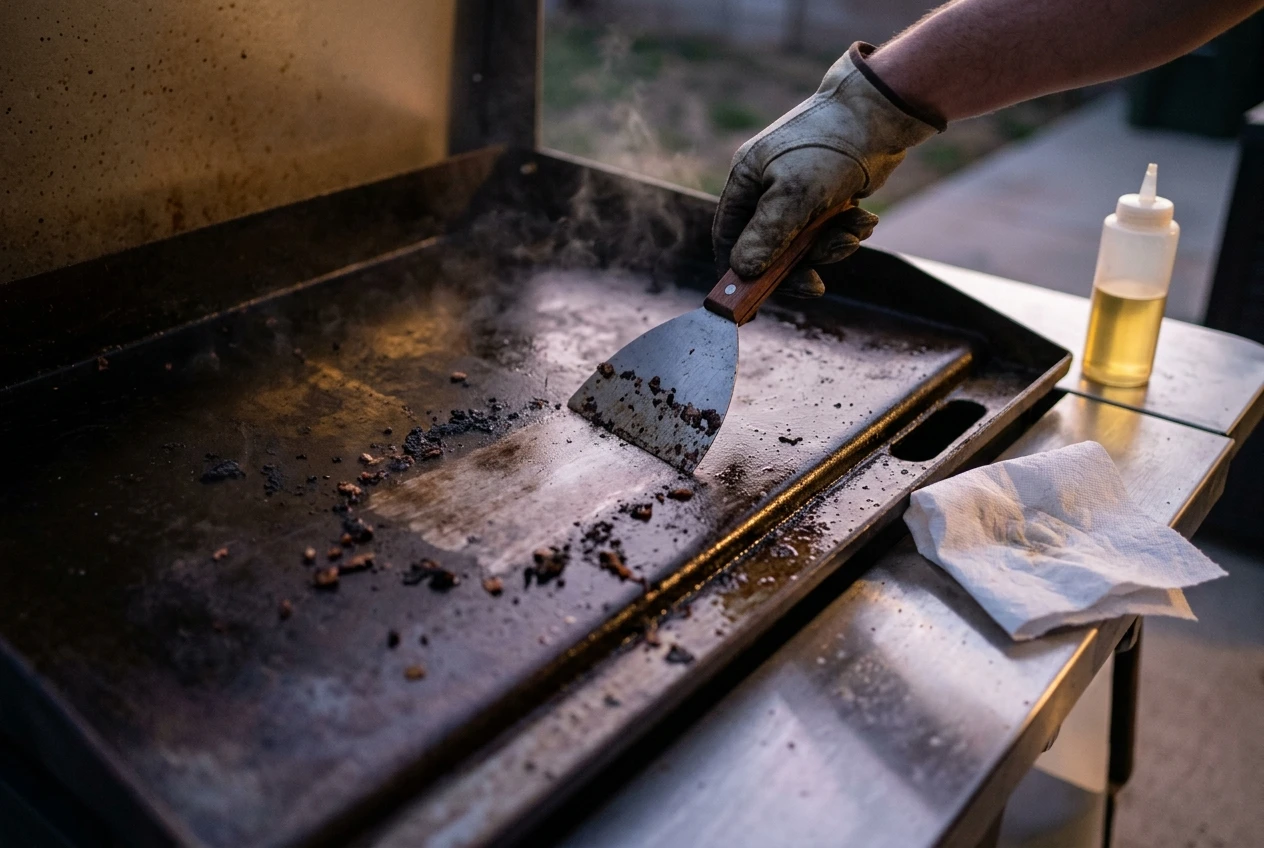
A griddle has one surface and no grates to scrub, which makes the basic cleanup quick while the steel is still warm. You scrape the debris into the grease trap, wipe the surface, and apply a thin coat of oil. That oil layer matters. Bare steel left wet or bare will rust, so cleaning and re-oiling is part of ownership, and the surface needs seasoning, a baked-on layer of oil, to stay non-stick. We walk through the steps in how to clean a Blackstone griddle.
A gas grill has more parts to deal with: grates, burners, heat deflectors, a grease tray and the inside of the firebox. After most cooks, a quick brush of the grates while they are hot is enough. Over a season, the grease buildup inside needs a deeper clean to prevent flare-ups and keep the burners firing evenly. If you like to keep a grill for many years, the routine in our gas grill maintenance guide is worth following.
In short, the griddle asks for a little work after every cook, while the grill asks for light work after each cook and a bigger job a few times a year. Cooking greasy food on a griddle, such as bacon or a pile of smash patties, produces a lot of grease to manage, so keep paper towels and a scraper at hand.
Space, storage and weather on a typical patio
A griddle has a large flat cooking surface, and most models do not have a tall lid or hood. That gives it a low profile, though the footprint can be wide. Many people also need to find room for a cover, a bottle of oil and the tools that go with it.
A gas grill is usually taller, because of the hood, but its cooking area may be smaller for the same footprint. Larger models with side burners and shelves take real space, so measure your patio before you shop. If you are working with limited room, our outdoor kitchen design ideas for small patios can help you plan the layout.
Weather matters more for the griddle, because exposed steel rusts. A good cover is essential, and many owners keep the surface oiled between uses, especially in damp climates or over winter. Grills are built from materials that tolerate the outdoors better, though a cover still extends their life, and the burners and grease tray need the occasional check regardless.
Fuel storage is similar for both: each cooker typically runs on a propane tank, so plan a safe spot for it away from the house and check which fuel type the model you buy uses before you commit.
Who should buy the Weber, who should buy the Blackstone, and who should own both
Buy the Weber gas grill if:
- Steaks, chicken, ribs, chops and burgers with a smoky edge are your regular menu.
- You like roasting or cooking larger cuts with the lid down.
- You want the traditional grill-marked look and flavor.
- You prefer light cleanup after each cook, with periodic deeper cleaning.
Buy the Blackstone griddle if:
- Breakfast, smash burgers, tacos, fajitas, fried rice or cheesesteaks are on your list.
- You often cook for a crowd and want everything done on one big surface.
- You like cooking in front of people and being able to see and adjust everything.
- You are willing to season, oil and cover the surface to keep it in shape.
Own both if:
- Your weekends alternate between brunch and a dinner of steaks or ribs.
- You host and want to run mains on the grill while sides and buns cook on the flat-top.
- You have the patio room for two cookers and the budget to match.
A pairing makes sense because the cookers barely overlap. A grill cannot make a proper smash burger or a pancake breakfast, and a griddle cannot roast a whole chicken under a lid. If you can only buy one now, pick the one that fits the food you cook most often, and add the other later.
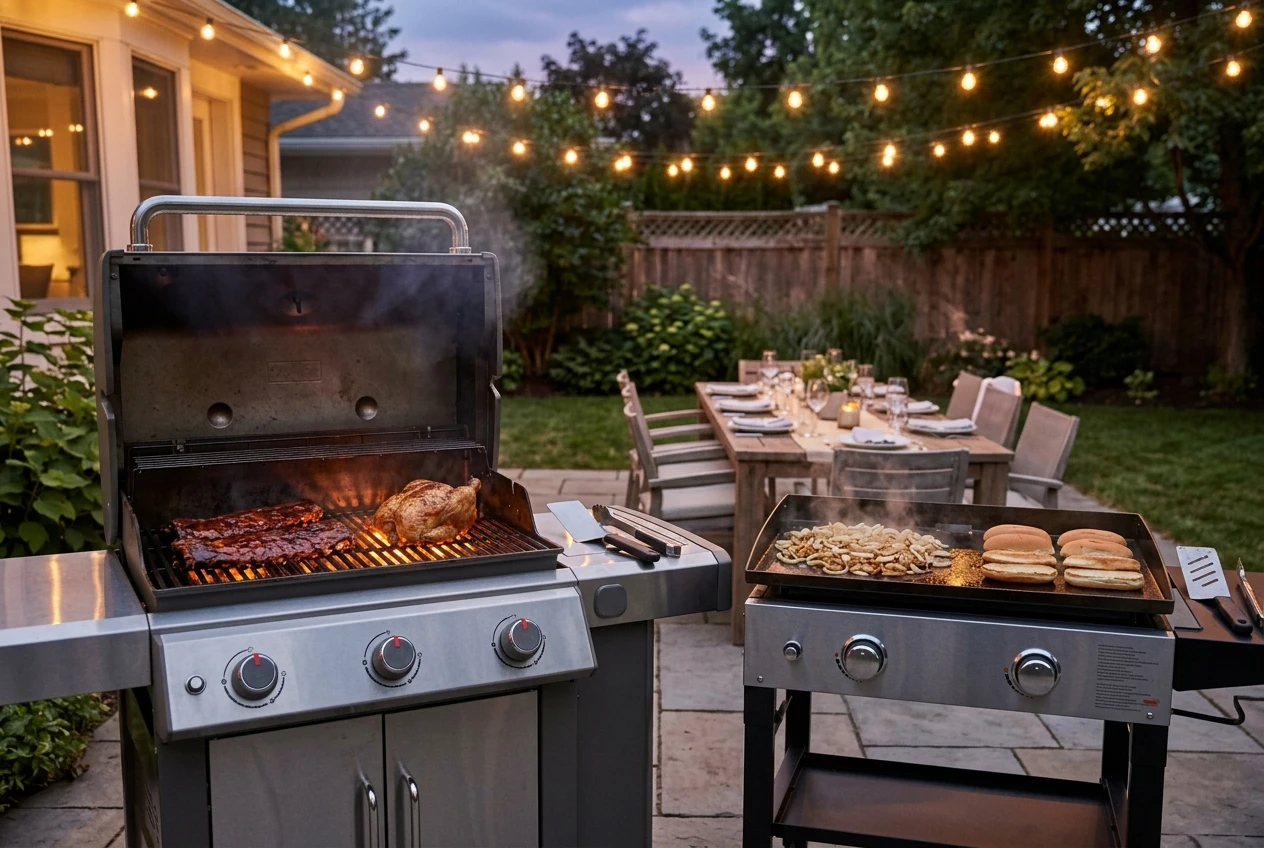
Quick decision guide: match your usual menu to a cooker
Find the line that sounds most like your typical weekend:
- “Steaks, chops and chicken pieces.” Get the gas grill.
- “Ribs, whole chickens or roasts.” Get the gas grill with a lid, and cook with indirect heat.
- “Smash burgers and cheesesteaks.” Get the griddle.
- “Pancakes, eggs and bacon for the family.” Get the griddle.
- “Tacos, fajitas and fried rice for a crowd.” Get the griddle.
- “Burgers and hot dogs, nothing complicated.” Either works. Choose based on whether you prefer smoky or seared, and which one is easier for you to clean.
- “A bit of everything.” Start with the grill if you want one cooker that covers the most ground, or with the griddle if breakfast and handheld food dominate. Plan on the second one later.
Once you know which category you fall into, the next step is to compare actual models. Read our full Weber Slate Griddle Review and Blackstone 28 Griddle Review, or see our Best Gas Grills 2026 roundup to compare current models and check prices through our affiliate links.